

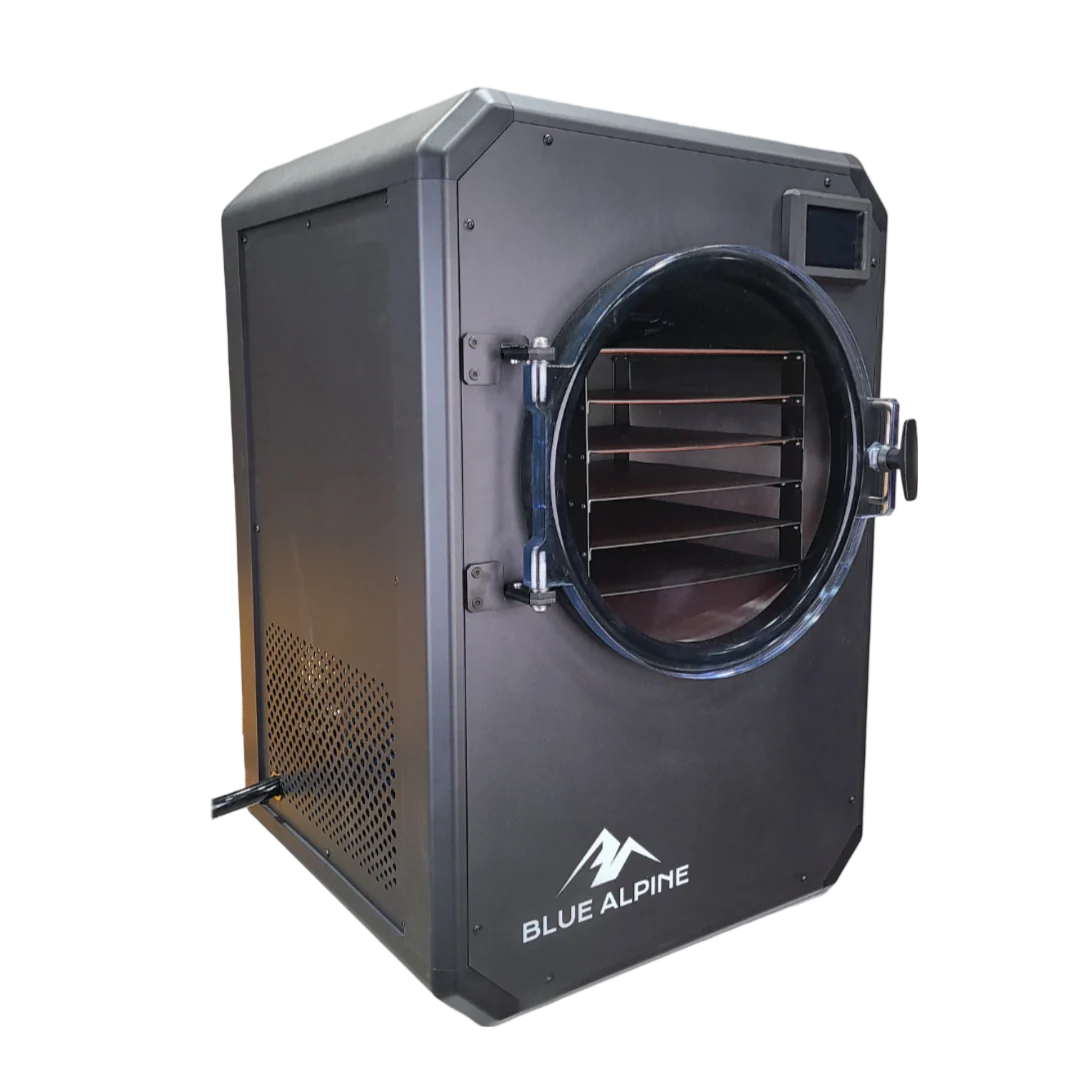
Elite adds per-tray sensors, a built-in fresh air valve, KF vacuum fittings and free colour choice, for $600 on the Medium and $700 on the Large. One of those four changes how a batch runs. The others are conveniences.
By Marta Reinholt · Updated 6 September 2026 · Affiliate links: we earn a commission on qualifying purchases, and it does not affect our verdict.
Which one to buy
Buy Select unless you already know why you want per-tray sensors. The chassis, the cooling, the pump, the trays and the published 12 to 20 hour cycle are identical between trims, so Elite is not a faster or larger machine — it is a better instrumented one. That matters if you dry varied loads and want to know what each tray is doing; it does not if you run fruit on a preset.
The price gap
| Chassis | Select | Elite | Difference |
|---|---|---|---|
| Medium | $2,995 | from $3,595 | $600 |
| Large | $3,995 | from $4,695 | $700 |
| XL Commercial | — | from $13,495 | Elite only |
What Elite actually adds
- Per-tray sensors. The one substantive difference. Instead of inferring the state of the whole chamber from one reading, you see each shelf. On uniform loads this tells you little. On a mixed load — fruit on one tray, cooked meal on another — it is the difference between guessing and knowing which shelf is holding the cycle up.
- Built-in fresh air valve. Controlled air admission at the end of a cycle, rather than cracking the door. Blue Alpine sell the valve assembly separately at $28.99, which puts a price on this part of the upgrade.
- KF vacuum fittings. A flange standard used in laboratory vacuum work. Cleaner to disconnect and reconnect than barbed fittings, and more relevant if you ever swap pumps.
- Free colour options. Select charges for colours other than the default; Elite includes all eight. Worth noting as part of the gap rather than a reason to spend it.
What is identical
This is the part worth being clear about, because the trim names invite you to assume otherwise. Both trims share the chassis and its dimensions, the load capacity, the tray size and count, the published 12 to 20 hour average cycle, the power draw, the R1270 refrigerant, the extruded aluminium frame, the inch-thick plexiglass door, the P100 chamber filter and the Premium pump. A Medium Elite does not dry faster or hold more than a Medium Select.
The review counts tell you something
Blue Alpine publishes 108 reviews on the Medium Select against 16 on the Medium Elite, and 51 on the Large Select against 5 on the Large Elite. Most buyers are choosing Select. That is not proof Elite is not worth it, but it does mean the Elite trims have a much thinner published track record, which is a consideration in itself on a machine you expect to keep for a decade.
Where the $600 goes further
If you are weighing the Elite upgrade on a Medium, compare it against the alternative uses of the same money: a full second tray set at $64.12, silicone mats at $32.31, tray lids at $68.00, a heat rack at $110.04 and the three-stage oil mist filter at $184.75 come to roughly $460 together. That collection changes what you can dry and how much of it per day. Per-tray sensors change how well you understand a cycle you were probably going to run correctly anyway.
The exception is the Commercial pump path. If you were going to buy the oil mist filter regardless, note that the $1,583 Commercial pump upgrade includes it — so the sensible order of spending is pump first, filter free with it, sensors last.
Blue Alpine Medium Select
Our pick of the two trims for most buyers. Elite from $3,595 if you want per-tray sensors. Prices verified 6 September 2026.
Read next
- Blue Alpine Medium Select review — the full specification and what is in the box.
- Blue Alpine vs Stay Fresh — the comparison most buyers are actually making.
- All six machines ranked.
More reviews